





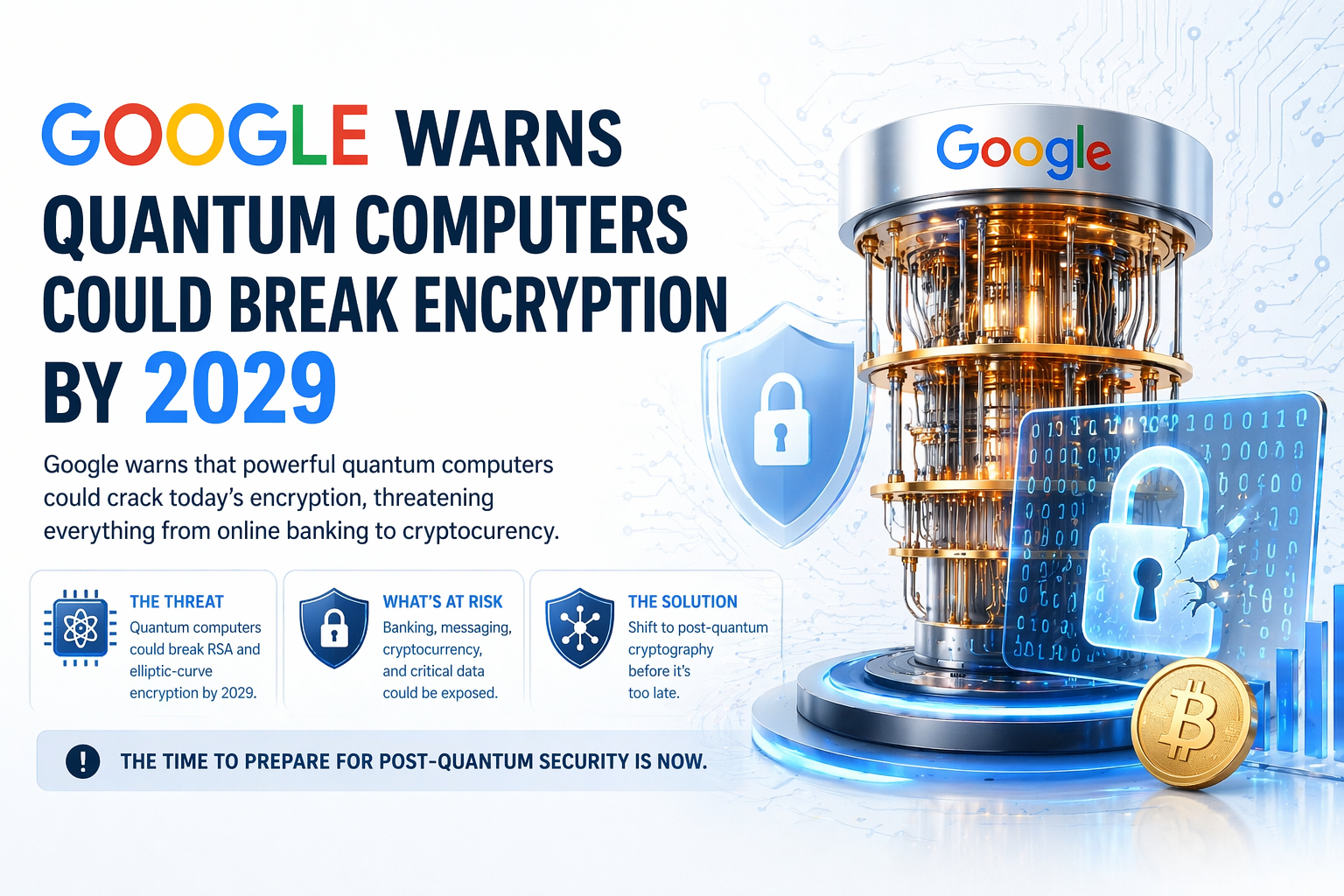
Google has warned that the era of quantum computers capable of breaking today’s encryption systems may arrive much sooner than expected, potentially as early as 2029, raising serious concerns for global cybersecurity and digital infrastructure.
According to recent research and industry reports, advances in quantum computing are rapidly reducing the technical barriers required to crack widely used encryption methods such as RSA and elliptic-curve cryptography, which currently secure everything from online banking to messaging platforms and cryptocurrencies.
Google’s findings suggest that a powerful quantum computer equipped with hundreds of thousands of qubits could break these cryptographic systems, marking the arrival of what experts call “Q-Day” — the point at which modern encryption becomes obsolete.
The implications are far-reaching. Cryptocurrencies like Bitcoin, which rely heavily on elliptic-curve cryptography, could become vulnerable to theft or manipulation if quantum capabilities reach the required scale. Researchers warn that attackers could potentially exploit exposed public keys during transactions, compromising digital assets within minutes.
Despite these concerns, experts emphasize that such quantum machines do not yet exist. However, the pace of innovation is accelerating, with new research indicating that far fewer resources may be needed to break encryption than previously believed.
One of the most significant risks highlighted is the concept of “store now, decrypt later,” where adversaries collect encrypted data today with the intention of decrypting it in the future once quantum technology becomes sufficiently advanced.
In response, Google and other technology leaders are urging governments, financial institutions, and the broader tech industry to begin transitioning toward post-quantum cryptography, a new generation of encryption designed to withstand quantum attacks.
The company has also accelerated its internal timeline, aiming to adapt its systems to quantum-resistant standards by 2029, significantly earlier than previous industry targets.
Cybersecurity agencies and experts worldwide are echoing this urgency, warning that failure to prepare could expose critical systems, sensitive communications, and financial networks to unprecedented risks.
While the quantum threat is not immediate, the growing consensus is clear: the transition to quantum-safe security must begin now, as the foundations of modern digital protection face one of their most significant challenges yet.