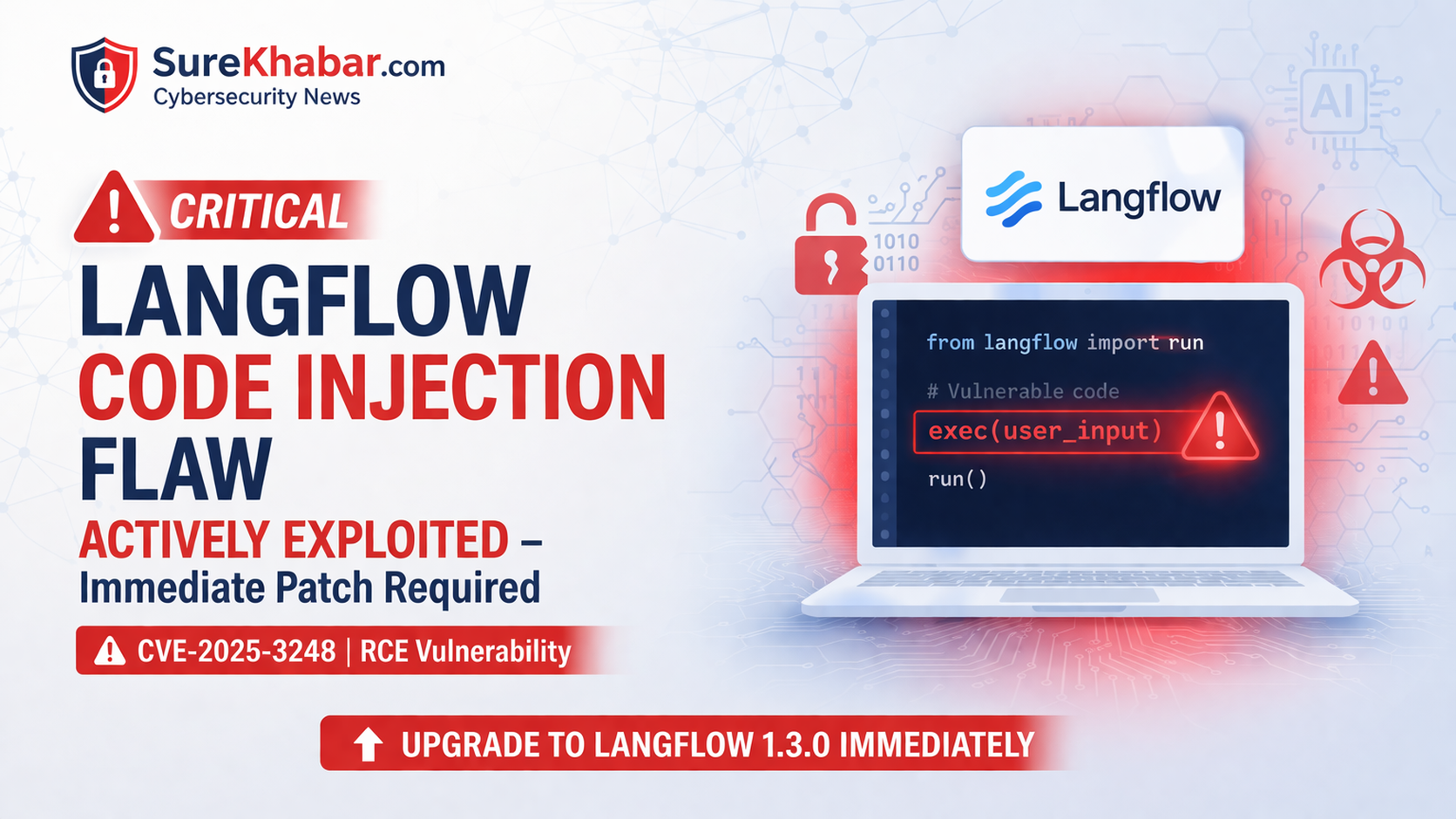
A newly disclosed critical code injection vulnerability in the open-source AI workflow platform Langflow is already being actively exploited by attackers, raising serious concerns across the cybersecurity community.
The vulnerability, tracked as CVE-2026-33017, allows unauthenticated remote code execution (RCE) through a publicly accessible API endpoint. Attackers can inject malicious Python code into workflow definitions, which is then executed directly on the server without any sandboxing or authentication checks.
Security researchers observed real-world attacks within 20 hours of public disclosure, even before any proof-of-concept exploit was released.
Attackers quickly leveraged the vulnerability to:
- Execute arbitrary commands on servers
- Extract sensitive data such as environment variables and credentials
- Scan the internet for exposed Langflow instances
- Deploy follow-up payloads for deeper system compromise
This rapid exploitation highlights how threat actors can weaponize vulnerabilities almost immediately after disclosure.
The flaw is particularly severe because:
- No authentication is required
- Exploitation can be done with a single HTTP request
- The injected code runs with full server privileges
- It can lead to data breaches, system takeover, and supply chain risks
In general, code injection vulnerabilities allow attackers to trick applications into executing malicious commands, often resulting in full system compromise
The Langflow vulnerability is a stark reminder that modern cyber threats evolve faster than traditional patch cycles. Organizations using AI tools must adopt proactive security measures to stay protected in an increasingly hostile landscape.