




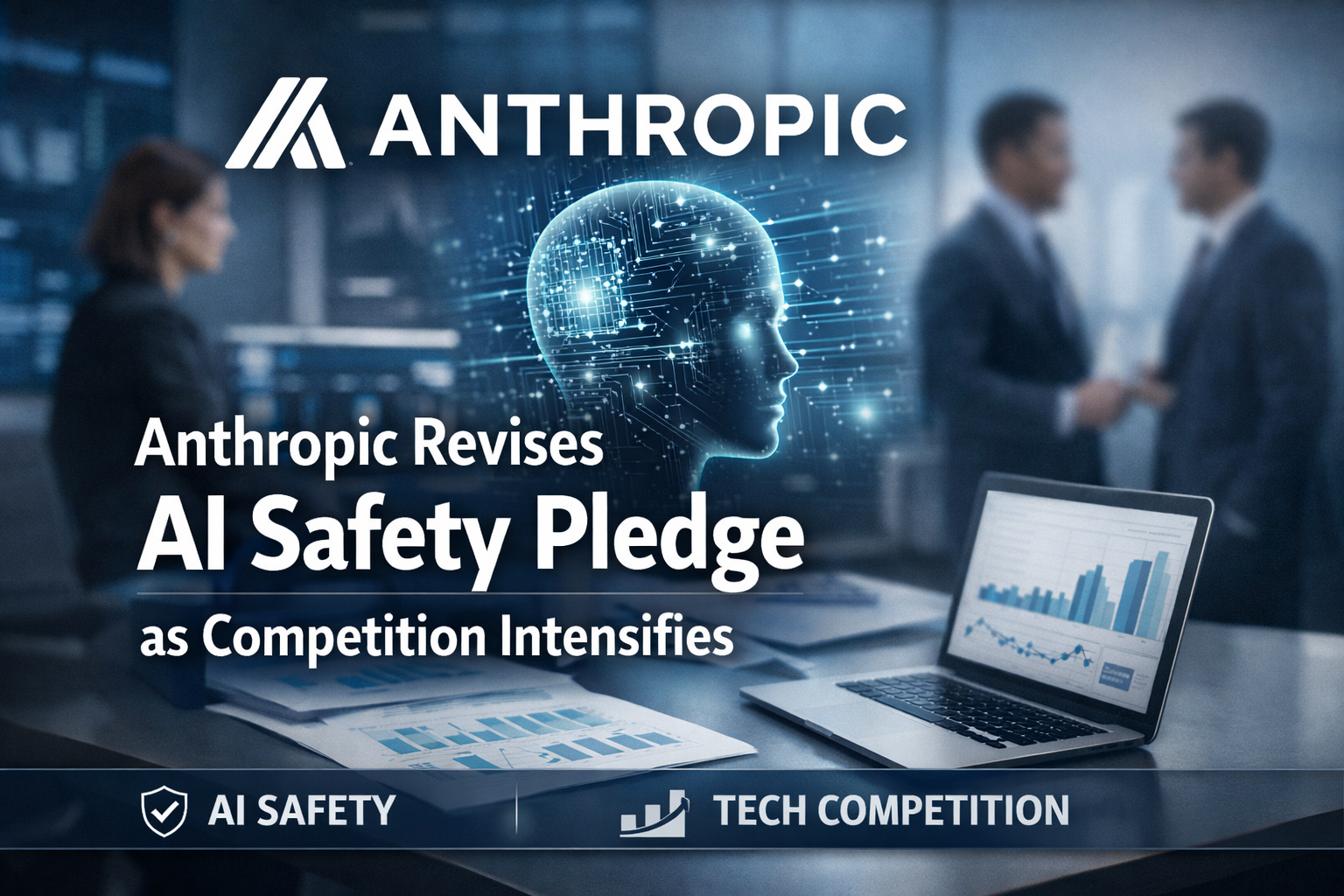
In a significant shift that highlights mounting competitive pressures in the artificial intelligence industry, Anthropic has revised a core element of its AI safety framework. The move marks a notable departure from the company’s earlier, more stringent commitments and underscores the growing tension between rapid technological advancement and responsible governance.
Anthropic acknowledged that the AI landscape has evolved at “blinding speed.” Competing laboratories are now releasing increasingly powerful models at a rapid pace, reshaping both technical benchmarks and market expectations.
The policy change comes amid aggressive expansion by competitors such as OpenAI, Google, and xAI, the AI venture founded by Elon Musk. These firms continue to push the boundaries of model scale, multimodal capabilities, and commercial deployment.
Anthropic’s original safety pledge helped set a benchmark across the sector, influencing peer companies and informing early discussions around state-level AI oversight. But without comprehensive federal regulation governing frontier AI systems, voluntary commitments remain largely self-enforced.
Executives at Anthropic argue that in the absence of binding rules, maintaining unilateral restrictions could place the company at a structural disadvantage.
Anthropic’s revised policy signals a pivotal moment in the evolution of AI governance. It reflects the broader industry dilemma: how to balance innovation, market leadership, and ethical responsibility in a rapidly accelerating technological race.
Whether this recalibrated approach will strengthen long-term trust — or mark the beginning of a wider retreat from voluntary safety guardrails — remains uncertain. What is clear is that the intersection of economic incentives and technological ambition is reshaping the standards that once defined the AI safety movement.
As the race toward more advanced machine intelligence intensifies, the debate over how — and how strictly — it should be governed is only just beginning.